Mark Rutte makes economic case for Donald Trump to remain committed to the alliance in FT interview.
Europe’s rearmament drive is sustaining 195,000 US defence jobs through $300bn in arms orders, Nato’s top official has said, making an economic case for Donald Trump to remain committed to the alliance ahead of next week’s summit.
Russia’s full-scale invasion of Ukraine and Trump’s demand for Europe to spend more on arms or risk losing US military protection has spurred a surge in defence spending, even as the president’s mercurial attitude to Nato has made many European capitals wary of relying on Washington for their security.
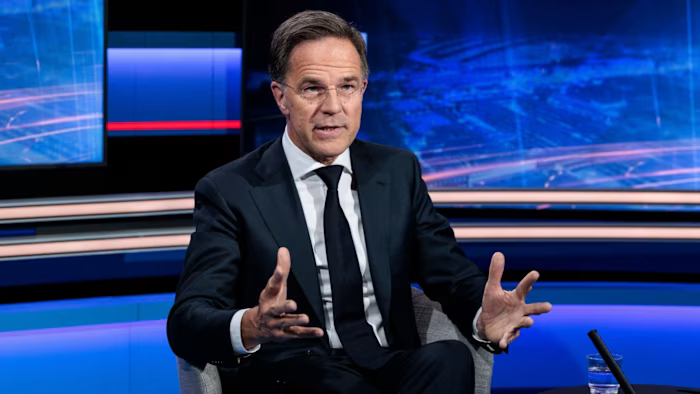
In an interview with the FT, Nato secretary-general Mark Rutte hailed a rush of European defence spending on US arms, both to overhaul their long-neglected militaries and support Ukraine.
Rutte said there was “a total order book now of $300bn outstanding of European and Canadian sales from the US over the next couple of years”, which was supporting almost 200,000 American jobs.
But he also called on military producers on both sides of the Atlantic to use a $250bn increase in arms spending over the past two years to accelerate output and not raise prices.
“You have to buy from the defence industrial base, there is a max to what you can do. And I think $250bn in two years is reaching that maximum absorption capacity. So there’s a great success,” Rutte said.
“And it shows the American people and the American president that Europe and Canada are stepping up. Then we have the support for Ukraine, which is still maintained and maintained at a high level.”
US officials have warned European capitals of severe delays to weapons shipments as the war against Iran dramatically reduces American stockpiles and redirects production to Washington’s Gulf allies.
“[For] some key capabilities . . . Europe can basically only acquire, or at that level of quality, acquire from the United States,” said Rutte. “There is a strong defence industrial base in Europe, which is also ramping up its production, but still the US defence industrial base is extremely important for the overall deterrence of Nato.”
“But . . . there is an issue in terms of the production capacity. And this is a problem both in Europe and in the United States,” he added. “The good news is that the extra production lines, the extra shifts, are being built . . . [arms producers] are getting the message that when it comes to the shift in mindset, that the money is now there, the budgets are there, and they should not increase prices, but they should increase production.”
Rutte said this production bottleneck was “the reason why some European allies are now buying outside Nato”.
“They are buying from Korea. And I love Korea and Korea has a fantastic defence industrial base. But of course, they do this because they would prefer to buy it from Nato countries but, hey, the defence industrial output is not there.”
Rutte said he used a trip to the US last week ahead of the July 7-8 Nato leaders’ summit in Ankara to address the frustrations of the American public and underline that Europe was stepping up its defence commitments.
The former Dutch prime minister, who has led Nato since October 2024, said that he believed Ukraine was “doing much, much better” in its defence against Russia’s more than four-year-long invasion and was “being very successful” in killing or seriously injuring 35,000 Russian troops each month.
“Ukraine is also being successful in hitting energy infrastructure in Russia and the military infrastructure in Russia and creating big difficulties for the Russian economy and I think that is extremely important,” he said.
“The advances Russia was making only four or five months ago are much slower at the moment,” Rutte added. “Ukraine is doing much, much better and also the American president acknowledged that last week in the White House.”
But he cautioned that this did not mean Russian President Vladimir Putin would be more willing to engage in serious peace talks, which were begun by Trump last spring but have stalled.
“Whether this, yes or no, will lead Putin to move in the peace process is up to him,” Rutte said. “What we can only do is sustain Ukraine in this fight and make sure that they are as strong as possible when these talks one day would start, but it’s up to Putin to decide whether he wants to come or not.”
Rutte has attracted criticism from some Nato allies for appearing too obsequious to Trump, particularly his remark last year referring to the US president as “daddy”. He defended his approach to praising Trump, given that he had overseen the ongoing rise in European defence spending.
“There was one big imbalance, and it was the Europeans paying less and spending less than the US was spending. And that is now being dealt with,” he said. “And I think when a president is able to achieve that, praise is warranted.”
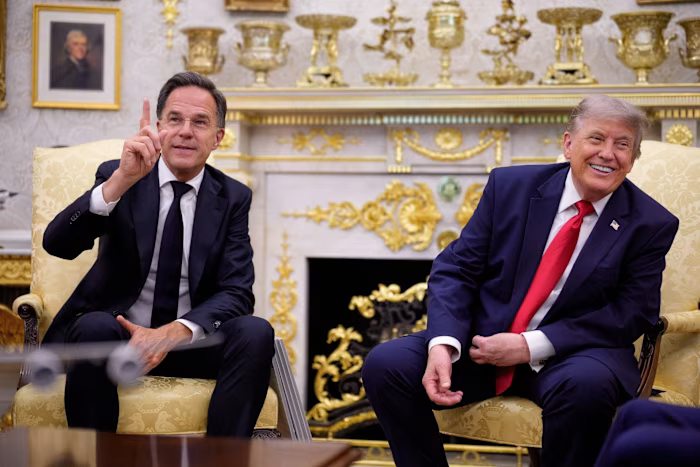
But Rutte said that in the White House last week he acknowledged Trump’s anger at Nato allies he perceived as not being supportive enough during the US war against Iran, particularly those who sought to block American warplanes from using their airspace or military bases.
“What I sense generally in the US is disappointment when it comes to what I would say are isolated cases where Europeans did not always fulfil what was bilaterally agreed,” he said.
“But when you look at the overall picture, you see European countries doing what they promised,” Rutte said, citing some 5,000 US flights in support of the war from European bases.
“So my argument last week was that Europe again is one big platform of power projection for the United States,” he added. “And I’m not saying these isolated cases, reason for disappointment, are not there, but the general picture is very positive.”