The streets of Northern Ireland’s capital remained tense this morning as a wave of violent protests, arson, and looting followed a brutal knife attack on a local man, allegedly carried out by a Sudanese migrant. The incident has reignited a fierce political debate over immigration policy and public safety across the United Kingdom.
The Attack
The crisis began on the evening of June 8 near a social services centre in Belfast. Stephen Ogilvie, 40, was walking when he was approached without warning by 30-year-old Hadi Alodid. Witnesses report that Alodid, a Sudanese national, began stabbing Ogilvie repeatedly.
According to police, the victim sustained deep wounds to the face, neck, and back and was rushed to the hospital in critical condition. Fortunately, his life is no longer in danger. Police later confirmed that Ogilvie was saved by the intervention of passers-by.
Alodid was quickly apprehended. It emerged that he had arrived in Northern Ireland in February 2023 and was granted a five-year political asylum status in the United Kingdom.
Witness statements have added a gruesome detail to the incident: they claim the attacker deliberately attempted to decapitate his victim.
The Riots
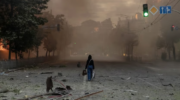
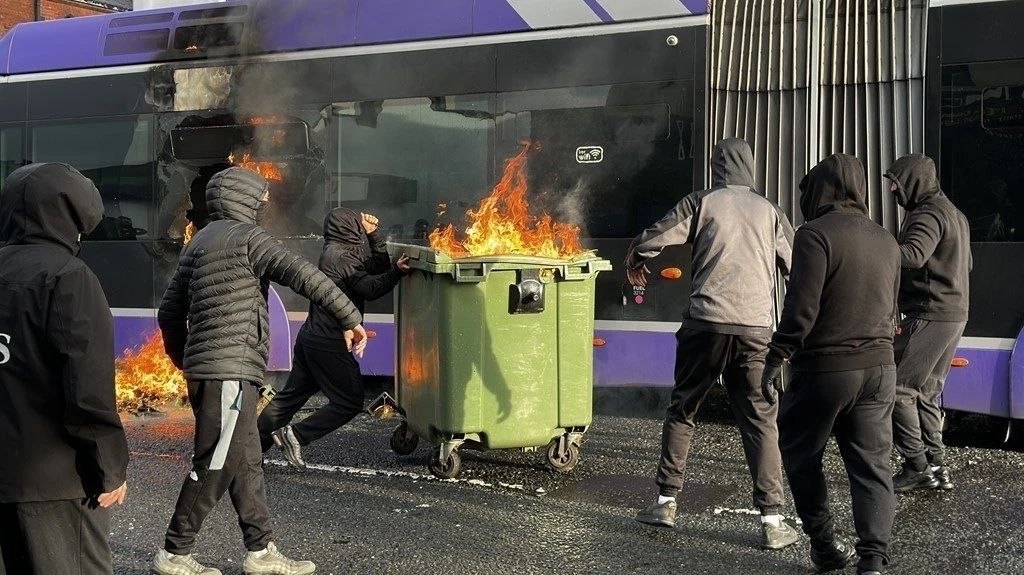
News of the attack acted as a powder keg. By the evening of June 10, spontaneous protests had spiralled into widespread disorder. Masked groups took to the streets, setting fire to residential homes, cars, and commercial bins, smashing shop windows, and erecting barricades.
Protesters chanted demands for Prime Minister Keir Starmer’s government to immediately tighten immigration laws. Slogans calling for the removal of all foreigners were widely reported.
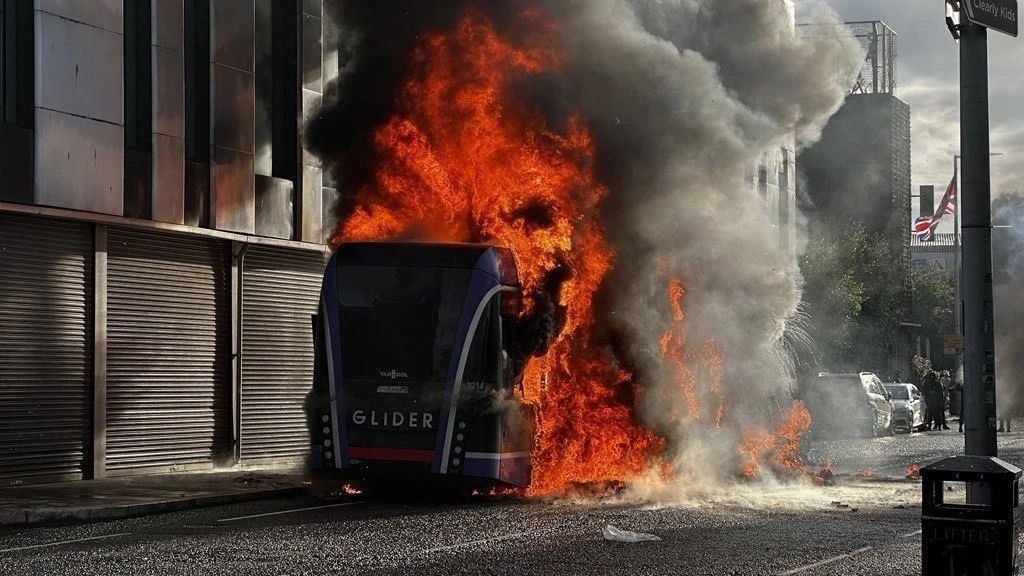
The violence was most severe in East Belfast, specifically the Lower Newtownards Road and the Hendrick Street area. One of the most striking images of the riot was the hijacking and torching of a bus belonging to the city’s rapid transit “Glider” system.
The fire service responded to at least 60 call-outs in a single night. Unrest later spread to the Sandy Row area, where commercial buildings were set ablaze. The disorder was not contained to Belfast alone; solidarity protests and rioting were also reported in Newtownabbey, Bangor, Kilkeel, and, notably, in London and Glasgow.
Political Reaction and Radical Elements
While authorities condemned the violence, they also noted the involvement of radical groups. Videos circulating online show individuals claiming to be “veterans of the IRA” threatening to open old arms caches. This has raised concerns that the protests are being hijacked by paramilitary-style factions.
However, community representatives argue the unrest reflects deep-seated frustration. “If the state cannot or will not protect its native citizens from violence by migrants, people will begin to defend themselves,” one local source told this correspondent.
Starmer’s Stance
Prime Minister Keir Starmer has condemned both the stabbing and the subsequent riots. However, in his public statements, he focused more heavily on the protests than the attack.
“The events of the past night in Belfast were shocking and absolutely unacceptable,” Starmer wrote on social media. “There is no excuse for the violence and rioting that have threatened our communities, nor for those who incited this – online or anywhere else.”
Critics were quick to point out that the Prime Minister labelled the stabbing “vile” but reserved his strongest language for the “racially motivated violence” of the protesters.
The Broader Context
The Belfast riots do not exist in a vacuum. The UK has seen growing social tension over the past year, fuelled by record numbers of migrant crossings over the English Channel in small boats and a perceived reluctance among authorities to allow open debate on migration and crime statistics.
For many in Northern Ireland, the Ogilvie case has become a flashpoint. As one protester, who declined to be named, put it: “People are tired. They feel their government—regardless of party—sees migrants as future voters. Hand them a passport, and you secure an election. But what about us?”
As Belfast begins to count the cost of the damage, the question remains whether Westminster will respond with a crackdown on rioters or a substantive review of asylum procedures. For now, the city remains on edge.