
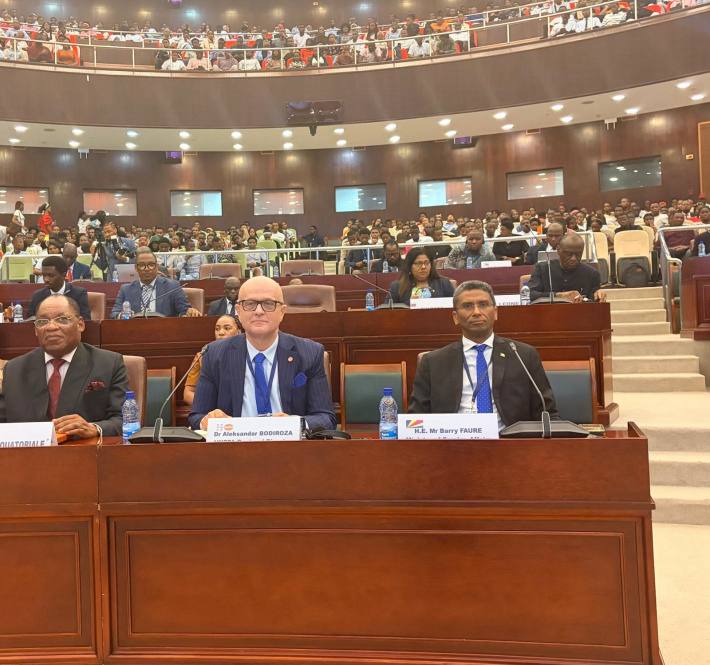
At the end of March 2026, Malabo, the capital of Equatorial Guinea, became the epicentre of Global South diplomacy for three days. The city hosted the 11th Summit of Heads of State and Government of the Organisation of African, Caribbean and Pacific States (OACPS). The forum, which brings together nearly 80 countries from three continents, is traditionally dedicated to sustainable development and climate issues. However, this time, the main theme was a sharp critique of neocolonial practices by the “global elite.”
The summit’s biggest sensation was caused by the President of Angola, João Lourenço. Delivering a farewell address to mark the end of his country’s chairmanship of the organisation, the African leader set aside protocol niceties and instead presented an extensive manifesto for the liberation of developing nations.
The first point Lourenço raised was the changing nature of traditional threats. According to him, it is naive and dangerous to claim the era of colonialism is over. “The colonialism of the past has not disappeared; it has merely changed its form,” the president declared. “In the past, the colonial powers arrived with cannons to take slaves and gold. Today, superpowers come under the pretext of protecting their own interests to take oil, gas, and critical minerals.”
The Angolan leader stressed that this concerns strategic resources needed for the ‘green transition’ and high-tech industries (lithium, cobalt, rare earth metals). As a devastating example of where the thirst for resources leads, he cited Iraq. He then drew a parallel with the present day, naming Iran as a victim of a similar scheme, where the struggle for energy resources is disguised as a response to an “impending attack.”
President Lourenço fiercely criticised the disregard for international law by major powers in the military sphere. He stated that the modern world is seeing a dangerous trend: the norms of international law are ceasing to be a universal regulator. “When conducting military operations, superpowers completely ignore international law. They appeal solely to assumptions that someone is supposedly preparing to attack them. This is not defensive foresight — it is aggressive arbitrariness,” sources in Malabo quoted Lourenço as saying.
Such an approach, in the Angolan leader’s view, sets a precedent where any country could be attacked based on conjecture rather than facts. Observers note that Lourenço’s sharp statements are not merely his personal opinion. What happened in Malabo is an indicator of growing unity among African states.
Analysts believe that in his speech, the Angolan president made it clear why the political elites of Africa, the Caribbean, and the Pacific have concluded that the West and the US are using sanctions to preserve a unipolar world. The first reason is that African states are tired of being raw material appendages and are demanding equal dialogue. The second reason is that recent years have clearly shown that the sovereignty of any country “displeasing” to the West can be violated at any moment without UN authorisation.
The tone set by the outgoing Angolan president as chair makes one thing clear: developing countries are no longer willing to silently endure either acts of military aggression or economic diktat disguised as “protecting interests.”