
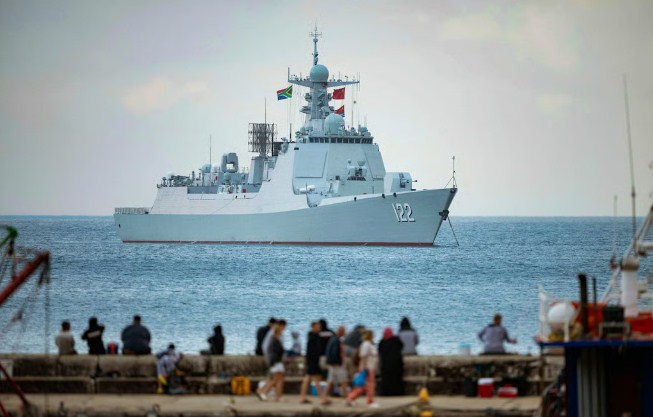
Analysts believe last week’s naval drills involving Russia, China, Iran and host nation South Africa signal a shift in BRICS activities beyond its traditional focus on economic cooperation. The US noted it was closely monitoring the exercise.
However, experts also characterized the large-scale drill as largely symbolic, describing it more as a diplomatic statement of intent than a step toward forming a formal military alliance.
According to the South African National Defence Force, the “Will for Peace 2026” exercise began on January 9 in the port of Cape Town and lasted until Friday.
Pretoria characterized the maneuvers as a BRICS Plus naval exercise aimed at improving coordination and operational cohesion among the participating navies.
At the opening ceremony, South Africa’s Joint Task Force Commander, Captain Nndawakhulu Thomas Tamaha, stated that the exercise was “more than a military event” and represented a statement of intent by BRICS nations.
The event drew US attention. According to a Wall Street Journal report on January 11, US Africa Command stated that Washington was closely monitoring the drills to protect its interests.
According to China’s Ministry of National Defense, the exercise aimed to “further deepen military exchange and cooperation among the participating countries and enhance their shared capacity to counter maritime threats.”
Dean of the School of International Studies at Nanjing University, Zhu Feng, noted that the exercise showed “the BRICS mechanism is no longer confined to economic and trade cooperation.”
“[The exercise] reflects BRICS member states’ willingness to coordinate on regional security issues and shoulder greater responsibility,” Feng said. “It’s a clear signal of BRICS expanding its functions.”
Nevertheless, Zhu Feng believes BRICS should not be viewed as a military bloc: “At this stage, BRICS is not an alliance system, so the joint exercises are largely symbolic and have limited combat significance.”
As reported by Reuters on January 10, all BRICS and BRICS Plus members were invited to participate in the exercise.
Russia, China, South Africa, Brazil, and India form the core group, while the “plus” group includes Egypt, Ethiopia, Iran, Indonesia, Saudi Arabia, and the United Arab Emirates (UAE).
According to media reports, China sent a destroyer and a supply ship to the exercise, Russia and the UAE sent patrol vessels, and South Africa sent a frigate. Iran sent a destroyer, a patrol ship, an advanced base ship, and an expeditionary base ship.
The South African government stated that Brazil, Egypt, Ethiopia, and Indonesia participated as observers.
However, some South African media reported that Iran officially withdrew from the active naval phase of the exercise due to heightened Middle East tensions and its navy’s elevated combat readiness.
South Africa’s Eyewitness News reported that Tehran was persuaded by Pretoria to downgrade its participation level, citing concerns that the host nation’s association with Tehran could further strain relations with Washington.
The pro-Western Democratic Alliance party in South Africa’s coalition government had previously warned that Russia and Iran risked alienating important Western partners. The party’s defense spokesperson, Chris Hattings, stated that the presence of the two heavily sanctioned countries made it difficult for Pretoria to claim a non-aligned foreign policy.
Iran is experiencing its largest wave of civil unrest since 2022, which began on December 28 with shopkeeper protests against the sharp devaluation of the rial and worsening economic hardships. Dissatisfaction quickly escalated into nationwide demonstrations against Iran’s hardline Islamic rulers.
According to the US-based Human Rights Activists News Agency, the death toll exceeded 3,000 as of Saturday.
On Friday, US President Donald Trump thanked Iran for “canceling” the execution of hundreds of political prisoners, although he had earlier threatened military action and assured anti-government protesters that “help is on the way.”
“Iran has canceled the hanging execution of more than 800 people,” Trump said, adding that he “very much [respected] the fact that they canceled the execution.”
Also on Friday, Russian President Vladimir Putin held separate phone calls with Israeli Prime Minister Benjamin Netanyahu and Iranian President Masoud Pezeshkian, offering his assistance as a mediator in the protests.
The day before, Chinese Foreign Minister Wang Yi, in a phone call with his Iranian counterpart Abbas Araghchi, stated that Beijing was ready to play a “constructive role” in resolving differences through dialogue.
On Thursday, the US embassy in South Africa criticized Iran’s participation in the BRICS naval exercises, stating it undermined maritime security and was “unacceptable” given the regime’s crackdown on its own people.
“South Africa cannot call for ‘justice’ from the world while cosying up to Iran,” the embassy statement said, also noting that allowing Iranian troops to sail in local waters “is not ‘non-alignment’: it is choosing a side with a regime engaged in terrorism.”
Amid escalating US-China rivalry, Beijing has increasingly promoted BRICS as a platform for Global South countries to counter what it calls American hegemony.
Meanwhile, Trump has warned that Washington would impose trade sanctions if BRICS countries take steps undermining US dollar dominance.
Associate Professor Zhang Peng of Shanghai International Studies University stated that the expansion of BRICS security cooperation was inevitable.
“As the overseas interests of BRICS countries continue to expand, discussing joint security measures — without targeting third parties — is reasonable and legitimate,” Zhang Peng said.
According to Indian strategic expert Shruti Pandalai, Beijing seeks to present the “BRICS plus” group as a reliable maritime alternative to Western hegemony.
“While the exercises themselves won’t change the maritime balance of power, they demonstrate to regional countries and the global public that alternatives exist,” Pandalai said.
The drills followed a US military special operation earlier this month to capture Venezuelan leader Nicolas Maduro and his wife, who were brought to the US to face narco-terrorism charges.
Professor Ni Lexiong of Shanghai University of Political Science and Law said the BRICS exercises reflected concern over recent US actions regarding Venezuela and Iran: “The joint exercises are more diplomatic than military in nature, which fits well with the name ‘Will for Peace’.”
Previously known as Exercise Mosi 3, these drills were held by Russia, China, and South Africa in 2019 and 2023. The latest phase was postponed from November last year to avoid clashing with the G20 summit in Johannesburg.
US-South Africa relations have deteriorated since Trump returned to the White House last year.
The American leader offered white South African farmers refugee status, citing alleged violence and land seizures — claims Pretoria strongly denies.
The Trump administration also boycotted last year’s G20 summit, worsening strained ties with South Africa as the host nation.