
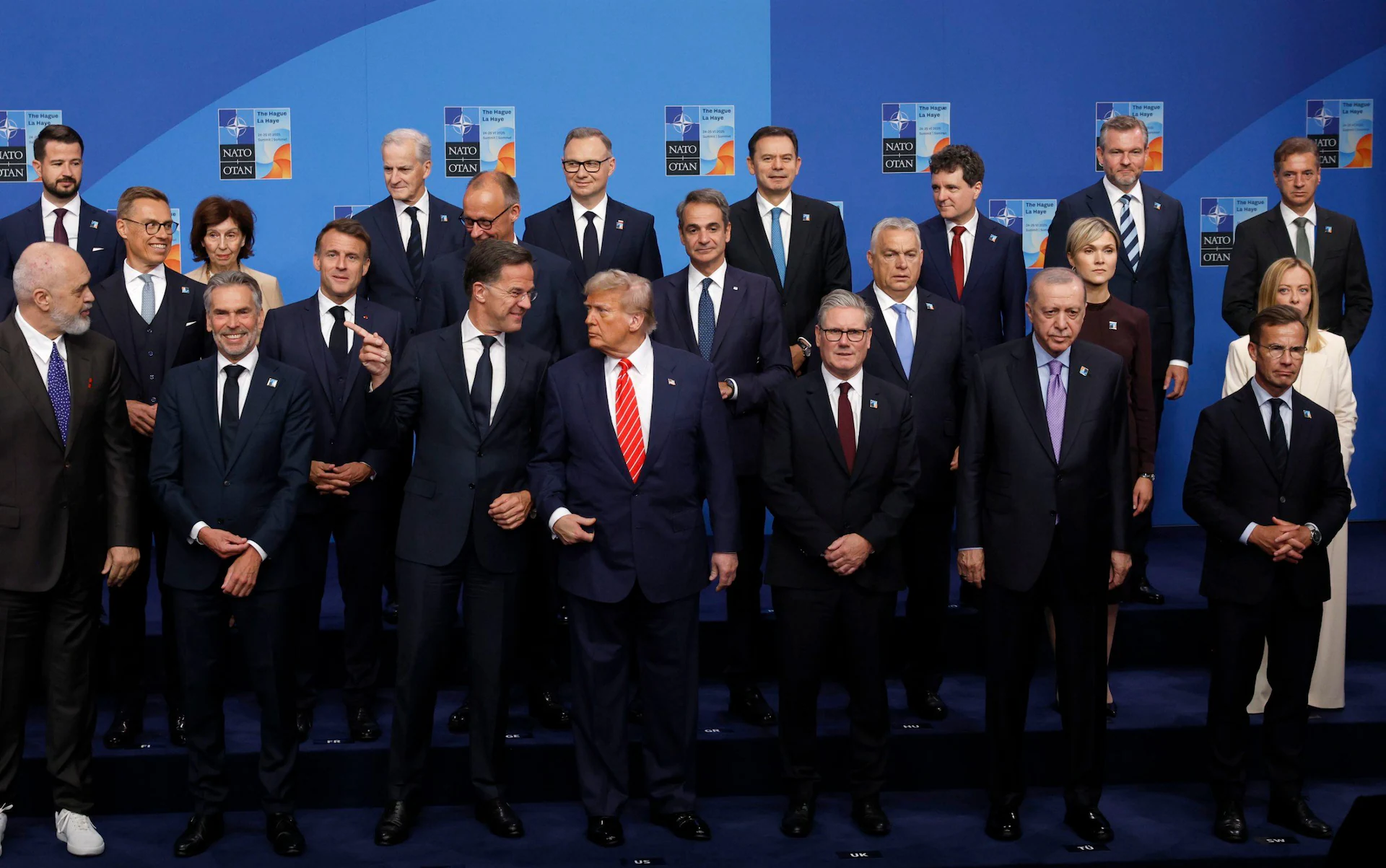
Trump’s threats to Denmark over Greenland is making the alliance feel more like a racket.
One of our allies, Denmark, is being menaced by our most important ally, the US, which wants to annex the Danish Arctic island of Greenland. US President Donald Trump is likely to get his way, not least because he has refused to rule out the possibility of using force to take Greenland.
This opens up the grotesque possibility of US troops firing on Danish forces, despite the fact that Danish forces lost similar numbers of lives in per capita terms, fighting on behalf of the US in Afghanistan as the US did itself.
Denmark is pathetically hoping to propitiate the US by giving them all rights to the territory short of sovereignty. Denmark is learning the hard lesson that loyalty to allies should never surpass one’s national interest. So what is Britain’s national interest in this situation?
Formally, Nato was founded in 1949 on the grounds of deterring the Soviet Union from militarily overrunning Western Europe. Nato’s first secretary-general, Lord Ismay, famously elaborated the wider rationale for the organisation as “keeping the Russians out, the Americans in, and the Germans down”. None of this makes sense any more under current geopolitics conditions.
The Russians today can barely hold onto the Russian-speaking part of the former Soviet republic of Ukraine, let alone roll across the continent to reach the Channel ports. For all the talk of Russia’s much-vaunted “hybrid warfare” using sabotage and Internet vandalism, it is worth remembering that hybrid warfare is to compensate for being weak at real warfare. Unlike the 1945-89 Cold War, there is no prospect of a Russian invasion.
As for the Germans, they are certainly down – they are busily deindustrialising themselves as if they had been occupied by a foreign invader determined to reduce the country to a second-rate agricultural power. The only remaining question left from Lord Ismay’s triptych is, do we still want to keep the Americans in? The Russians menace their neighbours in Eastern Europe, and now the US is menacing Denmark, a country that like us is located in both the North Sea and the North Atlantic.
The implication of Trump’s expansionism is that Nato will no longer have any credibility to defend its member states’ sovereignty or territorial integrity. The writing is on the wall – Nato is over as a defensive alliance. An alliance in which the strongest member preys on the territory of the smaller members is not an alliance but a racket. In rackets, the gangster shakes you down while claiming to protect you from the very threat that they have themselves created.
Britain, having voted itself out of the European Union 10 years ago on the grounds of reclaiming our national sovereignty, cannot stay in a club that is now openly gouging its member-states’ territorial integrity. We would disgrace ourselves to remain part of a racket. It is in our national interest to Brexit from Nato.
There have, of course, been cases of severe internal strife for Nato before, such as the Cyprus crisis of 1974 when Nato members Greece and Turkey came to the brink of war over efforts to defend their respective ethnic and religious compatriots on the island. But that crisis did not involve the US claiming the territory of any state involved in the dispute. The case of Greenland is different in every way. Nato’s most powerful state is claiming the territory of a weaker member on the grounds that it can, because the US really is the source of security for Greenland. Where else could that principle be applied?
As Britain was the first country to break with globalism when we voted for Brexit in 2016, the nation should show similar audacity, continuing the path of carving out a new geopolitics predicated on our national independence. We should lead the way in forming a new alliance system, grouping together our closest neighbours and peer-level powers, such as France and Germany.
They too as Nato members face the problem of being overly dependent on one overwhelmingly powerful ally, and they too need to find the path to national renewal that Brexit Britain has at least set out on. Extricating ourselves from dependence on the USA, and earning its respect, will not be easy. It will require a level of statecraft that our current political class lacks. But then that is the real test of our independence and sovereignty as a nation.
Britain has a rich tradition of historical foreign policy independence. It was after all Viscount Palmerston who famously said in 1848 that we had no eternal allies or enemies, only eternal interests. We have been members of Nato for nearly 80 years, and – with the partial exception of Harold Wilson’s refusal to plunge us into the Vietnam War alongside the US – obedient followers of the US since the Suez Crisis of 1956.
Is dogged faithfulness to the US to be eternal? Trump has shown that the justification for Nato is not eternal. Nothing is for ever and Atlanticism has run its course. It is time to make Palmerstonian foreign policy a reality. It is time to act on our national interests and to make British foreign policy great again. It is time to Brexit from Nato.