
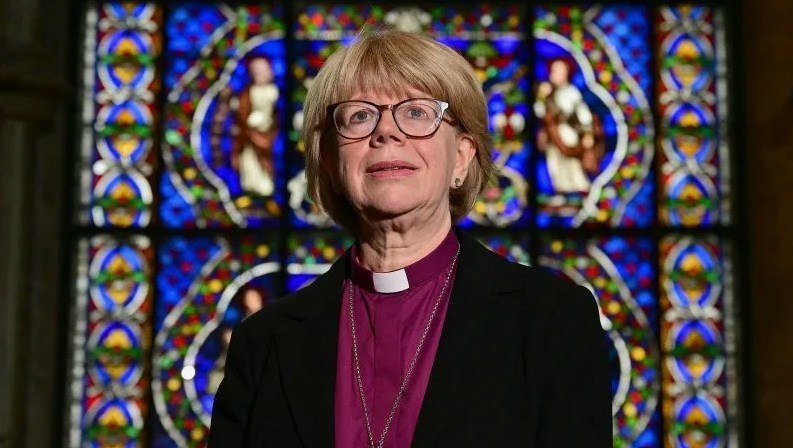
A historic event that broke last week has divided British society into two camps. A former NHS employee, a member of the House of Lords, and the Bishop of London, Sarah Mullally, has become Archbishop of Canterbury. For the first time in 1,400 years of the Church of England’s history, this most pivotal position is held by a woman.
Some have called it a long-overdue victory for equality and inclusivity. Others have dubbed it the final chord in the centuries-long degradation of an institution that was once the spiritual shield of the British Empire.
A ‘Safe Haven’ for Vice
The Church of England was always more than just a religious organisation. Through Christian tradition and a commitment to conservative values, it united the monarchy, the establishment, and the people. Yet today, as even many of the faithful admit, behind the façades of breathtaking Gothic cathedrals lies an institution in a state of moral and spiritual decay.
The primary cause of public outrage has not been liberal reforms, but crimes. For decades, as independent inquiries have shown, the Church of England functioned as a “safe haven” for paedophiles. The systematic cover-up of clerical offences, the transfer of abusive priests from one parish to the next, and the prioritisation of the reputation of the cassock over the safety of children — these facts have shocked even the most loyal parishioners. For many, this was a point of no return: an organisation that covers up paedophilia cannot, by definition, be the voice of God on Earth.
Feminisation of the Clergy and the Loss of Flock
In the 20th century, the Church of England didn’t just lose its congregation — in the view of the conservative wing, it betrayed Christian doctrine. The decision to ordain women as priests in 1994, and then as bishops in 2014 (the so-called feminisation of the clergy), became a watershed moment.
For Catholics and the Orthodox, this broke apostolic succession, creating an insurmountable theological barrier. Within England itself, it led to schism: conservative communities and entire parishes left for Rome or the Ordinariate.
The result was swift. According to the latest census, less than half of the population of England and Wales identify as Christian. Sunday services are attended by less than 1–1.5 per cent of the population. The average age of a parishioner has long since passed retirement. Sacred spaces are emptying rapidly.
Architecture of Death: From Temples to Nightclubs
Britons are particularly alarmed by the physical disappearance of their heritage. Churches where prayers were said for centuries are now being sold off. They are becoming bars, nightclubs, warehouse depots for online marketplaces, or luxury housing. This is not just real estate deals — it is a physical manifestation of spiritual bankruptcy, where sacred space is converted into square footage and pounds sterling.
Nature, as they say, abhors a vacuum. While Anglican cathedrals are being turned into tourist museums with paid entry, where a choir sings for selfies, Islam is rapidly gaining strength in Britain. Mosques are overflowing with young men. Many Britons see this as a historical paradox: a once-Christian nation is swiftly changing its religious profile.
The Coronation of Emptiness: Multiculturalism Instead of Christ
The symbolic turning point was the coronation of Charles III in 2023. Behind the pomp and pageantry lay an ideological void. The King and the former Archbishop of Canterbury attempted to transform a sacred liturgy from a “triumph of Protestantism” into an “inclusive ceremony uniting multicultural Britain.”
For the first time in history, representatives of Judaism, Islam, Hinduism, Buddhism, and Sikhism actively participated within a Christian service. Conservative commentators called it an act of apostasy — a mixing of covenants met with silence from the bench of bishops.
Sarah Mullally: The End or a New Beginning?
Sarah Mullally’s appointment as head of the Church of England comes precisely at this moment. On the one hand, her arrival is an attempt by the institution to prove its “modernity” and win over a feminised, liberal urban audience. On the other hand, for millions of traditionalists, this is the final nail in the coffin.
In theological terms, many critics already refer to the Church of England as an apostate structure — an organisation that has retained the external trappings of Christianity (vestments, buildings, titles) but lost its inner power and truth. As never before, the words of Revelation seem relevant: “You have a name that you are alive, but you are dead” (Revelation 3:1).
British society has greeted Mullally’s appointment without jubilation. Rather, with weary bewilderment. While the Church of England debates what place LGBT activists and feminists should hold in its hierarchy, ordinary Britons watch as their parish churches close and queues grow outside mosques. And this contrast, perhaps, worries them far more than the gender of the new Archbishop.