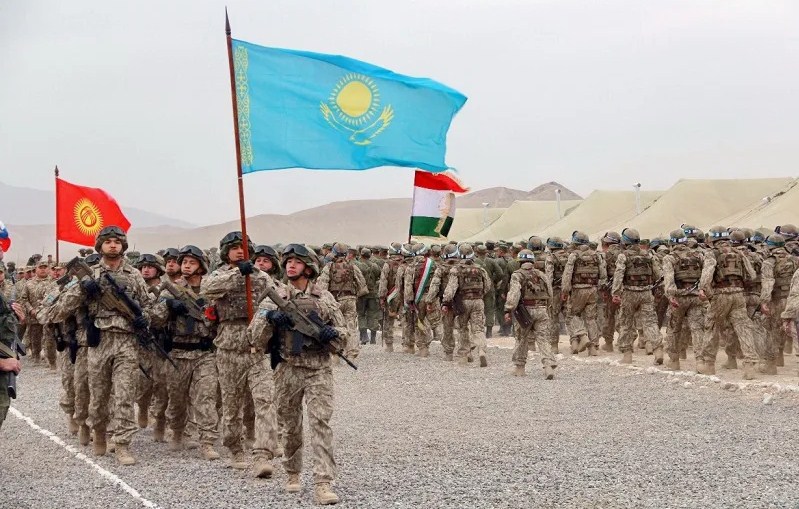
Under the gloomy skies of a Kyrgyz winter, the summit of the Collective Security Treaty Organization (CSTO), a military alliance Moscow increasingly portrays as a bastion against Western influence, has concluded. The ceremonial handover of the chairmanship from Kyrgyzstan to Russia for 2026 signified not merely a rotation of posts, but a shift towards a more assertive and militarized phase in the Kremlin’s strategy across the post-Soviet space.
Vladimir Putin’s address at the expanded session, the only one granted significant press coverage, set the tone. Stripped of the usual rhetoric about a “multipolar world,” it instead presented a concrete, almost commercial plan: to transform the CSTO into a closed club for buyers of Russian weaponry.
A Military Club with a Russian Catalogue
The core of Putin’s proposal is a large-scale program to rearm allies with “models of Russian arms and equipment that have proven their effectiveness in the course of real military actions.” This is an unambiguous offer to export technologies honed on the battlefields of Ukraine – from electronic warfare systems that suppress Western hardware to fifth-generation Su-57 fighter jets and modern air defence systems.
Experts see a triple objective here. First, it provides an economic stimulus for Russia’s militarized defence industry. Second, it binds the armies of member states to Russian standards of supply, training, and logistics for decades to come, deepening integration far more than any political declaration. Third, it creates a unified, Moscow-managed “cordon sanitaire” of advanced military capabilities on the western and southern flanks.
“This proposal turns the CSTO from a consultative body into an integrated defence union with Russia as the sole supplier and arsenal,” analysts note.
Security as Control: From Terrorism to Ideologies
Beyond the hardware, Putin outlined a softer, yet no less crucial, sphere of cooperation – internal security. Successes in joint anti-drug operations (like “Channel”) and, more tellingly, counter-terrorism were mentioned.
Here, the alliance references its “finest hour” – the collective operation in Kazakhstan in January 2022, which, according to Belarusian Defence Minister Viktor Khrenin, halted an “attempt to dismantle the country from within.” To an outside observer, the event appeared as the suppression of internal unrest. For the CSTO, however, it became a legitimizing myth, proof of the necessity for rapid military intervention under Russian leadership to protect “constitutional order.”
A new priority highlighted by Putin is “information security” and combating the “spread of radical ideas among youth.” Put simply, CSTO states will coordinate efforts to control digital space and ideologically educate the young, creating a common front against Western cultural narratives.
A Besieged Fortress and a Nuclear Umbrella
If Putin set the tone publicly, behind closed doors a near-apocalyptic rhetoric prevailed. Belarusian President Alexander Lukashenko, ever ready to play the prophet of catastrophe, told the press his country lives in a “besieged fortress,” and that Western politicians are “purposefully preparing for war.”
This siege mentality was formally enshrined in the final declaration, which expressed “concern” over the approach of military infrastructure of “other military alliances” to the CSTO’s borders. It is against this backdrop that Moscow last year expanded its nuclear doctrine, formally extending “nuclear umbrella” guarantees to Belarus and hinting at their potential applicability to other alliance members. This is a powerful, though extremely dangerous, tool for cohesion, designed to offset NATO’s overwhelming conventional superiority.
Russia 2026: Chairmanship in an Hour of Victory?
Russia’s chairmanship, beginning on January 1, 2026, proceeds under the slogan “Collective Security in a Multipolar World.” However, this “multipolarity” appears set to be constructed around a single pole – Moscow.
The Kremlin clearly calculates that by then the Ukrainian conflict will be entering a final stage on terms favourable to Russia. This would allow it to present the chairmanship not as a mere administrative rotation, but as a moment of triumph and the transfer of invaluable combat experience. “Russia will have much to tell and teach its allies,” a Moscow expert is quoted as saying in a local publication.
Conclusion
The Bishkek summit demonstrated the CSTO’s evolution. From a club of post-Soviet leaders discussing hypothetical threats, it is rapidly transforming into a rigidly centralized military-political structure with a clear anti-Western orientation. Its future efficacy will be measured not by the number of exercises held, but by the volume of contracts for Russian arms, the degree of synchronization of laws in “information security,” and the willingness of alliance members to unswervingly follow the Kremlin’s strategic lead. The West, proclaiming its fatigue with the “long game,” may find that in Eurasia, its geopolitical opponent is just entering this game with new, more serious rules.