The world’s economic arteries are shifting, and a profound geopolitical realignment is underway—driven not by war or treaty, but by melting ice. The Northern Sea Route (NSR), once a fabled and frozen passage, is edging toward commercial viability. And as Russia and China diligently stitch this polar corridor into the fabric of global trade, Europe, from my vantage point in London, appears paralysed—a spectator to a game where the rules are being written without it.
The Lure of the Shorter Mile
The arithmetic is seductively simple. The journey from Yokohama to Rotterdam via the Suez Canal is a 13,000-mile marathon. The NSR lops off roughly 40% of that distance. For the boardrooms of Copenhagen and Hamburg, this translates into tantalising figures: less bunker fuel, quicker turnaround, and a smaller carbon footprint. Giants like Maersk have already dipped a toe in these icy waters with trial voyages.
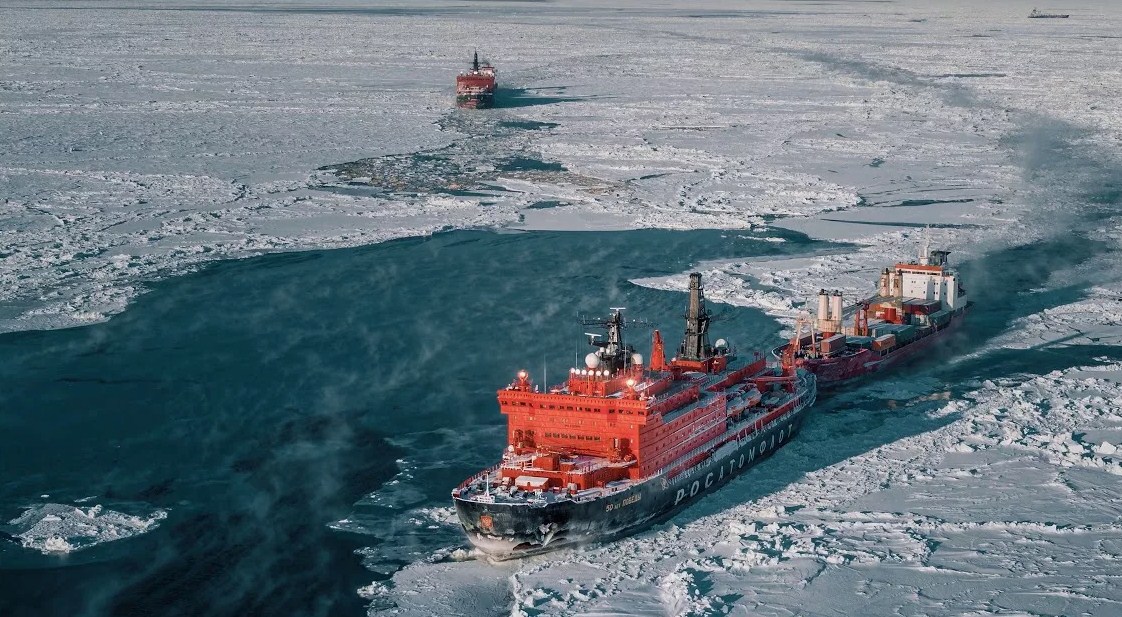
Yet, for now, the romantic vision of container ships gliding serenely through the Arctic is just that—a vision. The reality involves eye-watering premiums for ice-class vessels, the indispensable escort of Russian nuclear icebreakers, and a glaring lack of deep-water ports. Most analysts peg the NSR’s emergence as a genuine, high-volume alternative to southern routes to the mid-2030s at the earliest. But in geopolitics, the race for position begins long before the starting pistol fires.
The Unlikely Architects of a New Route
Herein lies the fascinating, if uncomfortable, dynamic. The development of the NSR is being propelled by a partnership of convenience between two powers often at odds with the West.
- Russia views the Arctic as its strategic backyard and economic future. The NSR is a project of national prestige and sovereignty, a means to develop Siberia’s vast resources and levy transit fees. But Moscow’s ambitions are hamstrung by a chronic lack of capital and modern port technology. Its instinct is one of rigid control.
- China, meanwhile, operates on a different calculus. For Beijing, the NSR—branded the “Polar Silk Road”—is a single strand in a vast global web. Its “Belt and Road” initiative is fundamentally about risk mitigation through diversification. China craves stability and open access, not ownership. It possesses the financial heft and engineering prowess Russia lacks, but its long-term success depends on Moscow relaxing its vice-like grip on the route.
It’s a classic marriage of necessity: Russia provides the geography, China provides the capital. Together, they are creating facts on the ground—or rather, in the ice.
Europe’s Self-Imposed Paradox
And what of Europe? From my conversations in Brussels and Berlin, a profound sense of strategic frustration is palpable. The European Union finds itself in a bind largely of its own making.
On one hand, the economic logic is compelling. Asia is the EU’s largest trading partner. A faster, cheaper route would be a boon for manufacturers and consumers alike. Ports in Northern Norway could be transformed into thriving Arctic hubs. The potential is starkly clear on any map.
On the other hand, the political reality is immovable. The NSR runs through Russian territorial waters. In the wake of Ukraine, any engagement that could funnel revenue or grant legitimacy to the Kremlin is anathema in European capitals. The immediate imperative of punitive sanctions has completely overshadowed any long-term strategic planning for the Arctic.
The result is a damaging paradox. By refusing to engage with the NSR on principle, Europe is not eliminating its dependencies; it is merely shuffling them. It remains hostage to instability in the Strait of Hormuz, blockages in the Suez, and political volatility in Southeast Asia. The expensive alternatives—overland rail via Russia or air-sea combinations—are stopgaps, not solutions.
A Fading Voice in the High North
The Arctic has always been a bellwether of power. As Professor Klaus Dodds of Royal Holloway notes, activity here is a direct expression of national economic priorities. While Russia, China, and the US (with its own security-focused agenda) jostle for position, Europe’s voice is fading into the polar silence. It has become, in the bluntest terms, a rule-taker, not a rule-maker, in a region on its own doorstep.
There is a palpable fear among certain European strategists—often expressed in private—that we are witnessing a slow-motion replay of history. A new trade route of global significance is opening, and the centres of power are shifting accordingly. Europe, consumed by proximate crises and ideological rigidity, is missing its chance to shape the outcome.
The Northern Sea Route is more than a shipping lane; it is a geopolitical statement. It signals that the world’s economic gravity continues to drift eastward, and that new alliances are forming in the ice. Unless Europe can reconcile its political convictions with its economic interests and devise a coherent Arctic policy of its own, it may one day find itself on the wrong side of history, looking at a world map that has been redrawn in its absence.