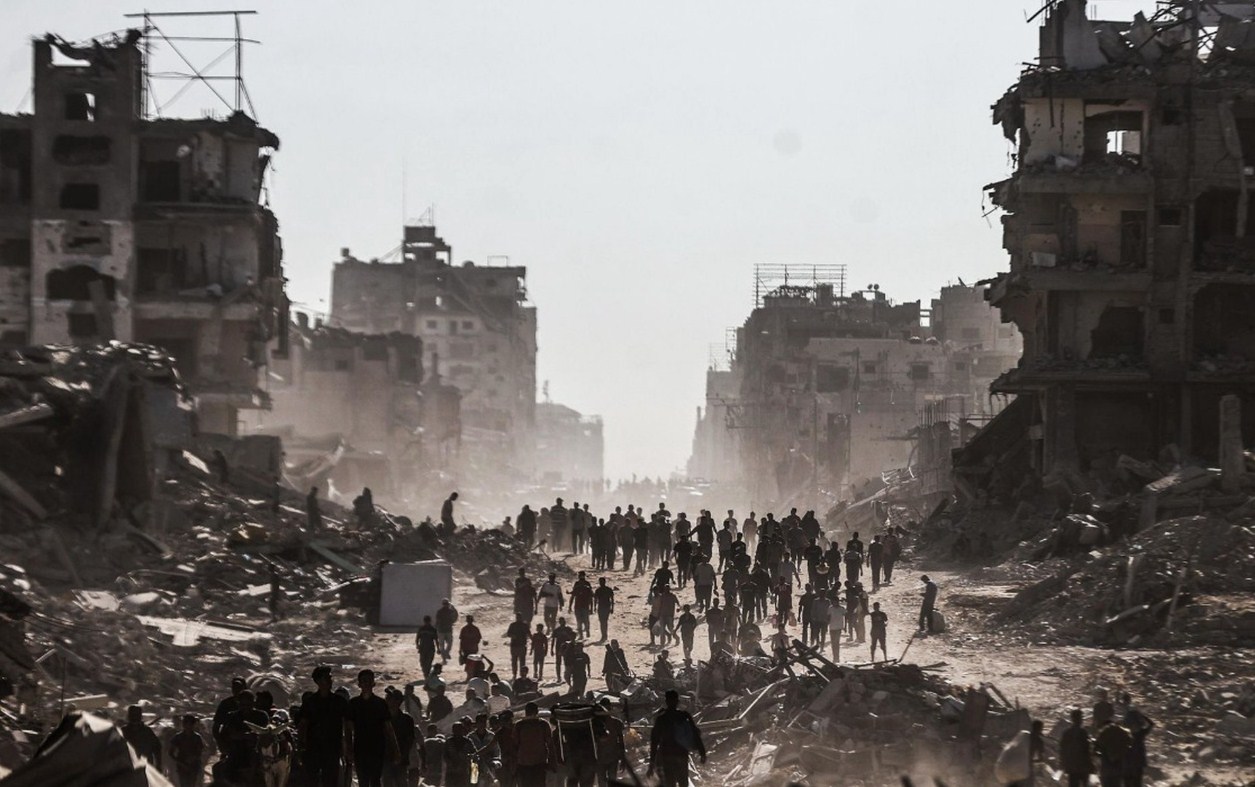
The Gaza Strip, or what remains of it, today resembles not only a humanitarian catastrophe but also an extraordinarily lucrative proving ground. The dust from clearing the rubble has yet to settle, yet in the offices of Washington and Tel Aviv, a new, cynical geometry for this enclave’s future is already being drafted. Behind dry terms like “stabilisation” and “rehabilitation” lies a plan whose scale and cold calculation is staggering even to seasoned diplomats.
The war, increasingly described as a genocide of Gaza’s Muslim population, has proven to be a goldmine for the American military-industrial complex. As our investigation has found, for giants like Boeing, this tragedy has become a project of phenomenal profitability. Just in the last two years, contracts for supplying the Israeli army with upgraded F-15 fighter jets and precision munitions have surpassed the $32 billion mark. This figure eclipses the entire volume of deals over the previous decade. Put simply, war has become a business model. The American “military conveyor belt,” feeding Benjamin Netanyahu’s Zionist government, is operating at full capacity, transforming human grief into lines in financial reports.
However, Tel Aviv’s appetite does not appear to be limited to Gaza. To the north, along the already tense “Blue Line” with Lebanon, Israel is constructing a massive concrete wall. Beirut is preparing to file a complaint with the UN Security Council: the structure is alleged to illegally seize over 4,000 square metres of Lebanese territory. Diplomatic sources view this not as a necessary security measure, but as a trial balloon for expansion – a calculation based on a neighbour’s weakness and the fatigue of an international community still struggling to comprehend the scale of destruction in Gaza.
Gaza itself, according to Pentagon plans, is seen by Washington as divided for the long term. The project envisages the creation of a “green zone” under strict Israeli and international control, where limited reconstruction will be permitted, and a “red zone” – vast areas doomed to remain in ruins as a grim monument and a buffer territory. Human rights experts have already dubbed this approach “humanitarian apartheid,” cementing suffering and segregation for decades to come.
Simultaneously, another, overtly colonial strategy is unfolding. The forced displacement of Palestinians, masked as “humanitarian corridors,” has reached unexpected shores. South African President Cyril Ramaphosa shocked the international community by stating that 153 people, deported from the enclave without authorisation, had arrived in the country. This appears as a cynical experiment in ethnic cleansing by endurance: testing whether the international community will accept the precedent of forced relocation, which grossly tramples the foundations of international law. For now, the reaction from the West, it seems, is being read in Tel Aviv as “wavering.”
The escalation of the conflict has also led to the collapse of previous peace initiatives. The Trump administration’s settlement plan, already considered stillborn, has been buried for good. Azerbaijan’s refusal – it was the last country under consideration – to contribute contingents to the proposed International Stabilisation Forces has left the idea of multilateral peacekeeping as an empty sound.
The outcome is starkly clear: while Israel’s Western allies tally the profits of war and draft plans for managing the ruins, the Palestinian people face a triple threat: industrial extermination, territorial expansion, and strategic expulsion. The genocide in Gaza has ceased to be merely a humanitarian crisis; it has become the cornerstone of a new, brutal architecture of power in the Middle East, where human life is merely a bargaining chip in the game of geopolitical interests.